
India's Most Trusted Source for Construction Mixing & Moulding Machines — 170+ Verified Manufacturers, BIS IS 1791 Certified Concrete Mixers, Pan Mixers, Planetary Mixers & Hydraulic Moulding Machines for Tiles, Paver Blocks & Precast Elements
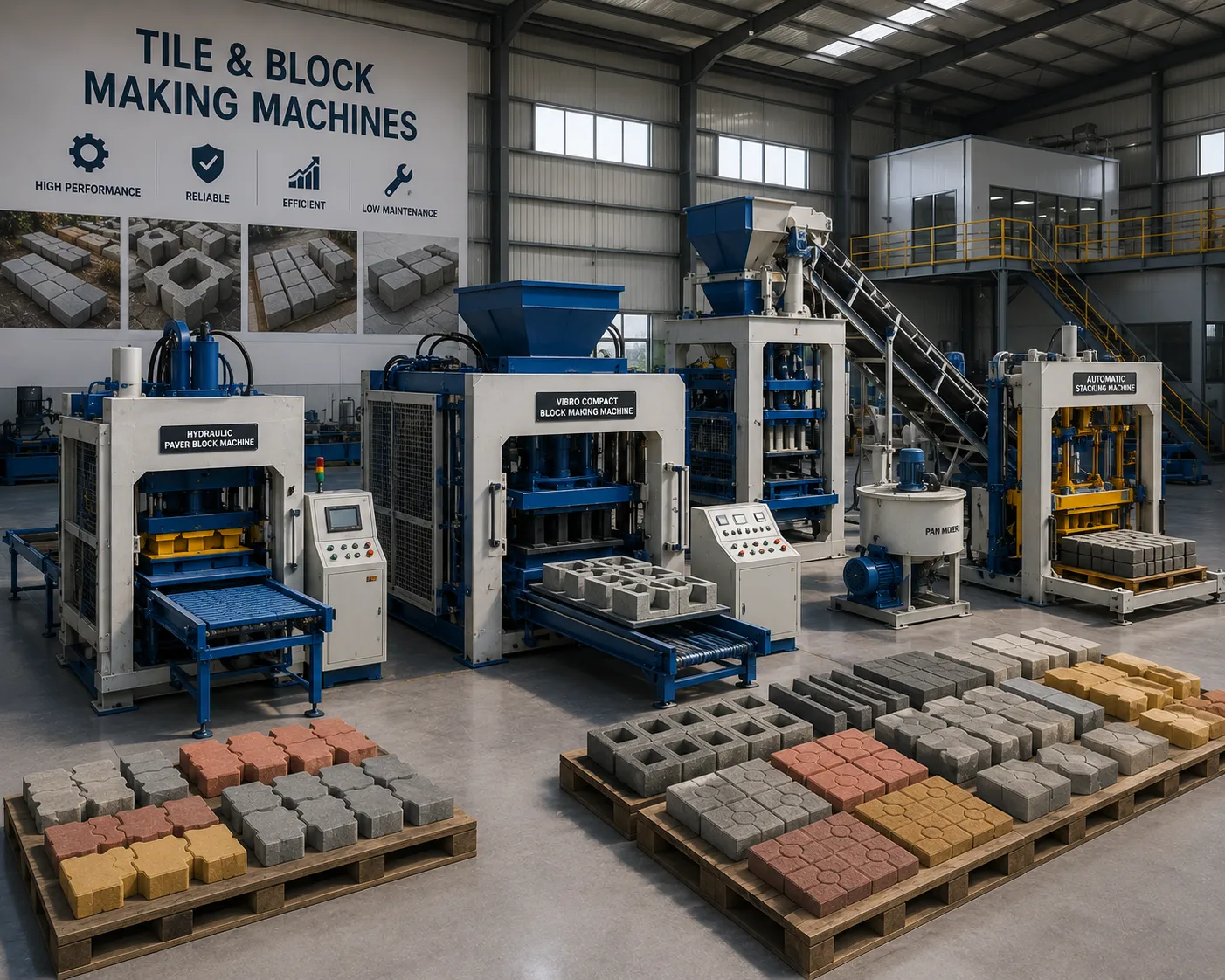
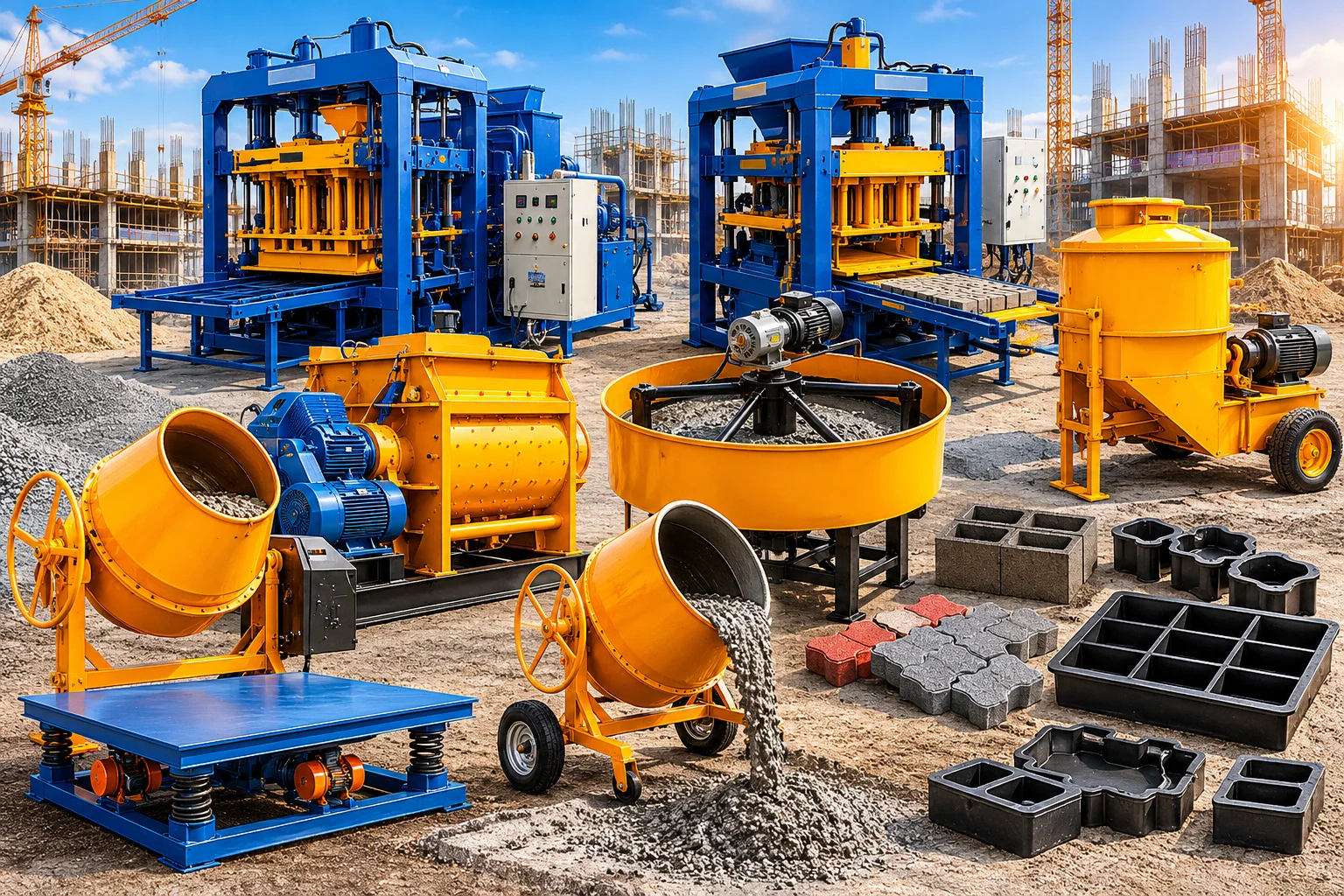
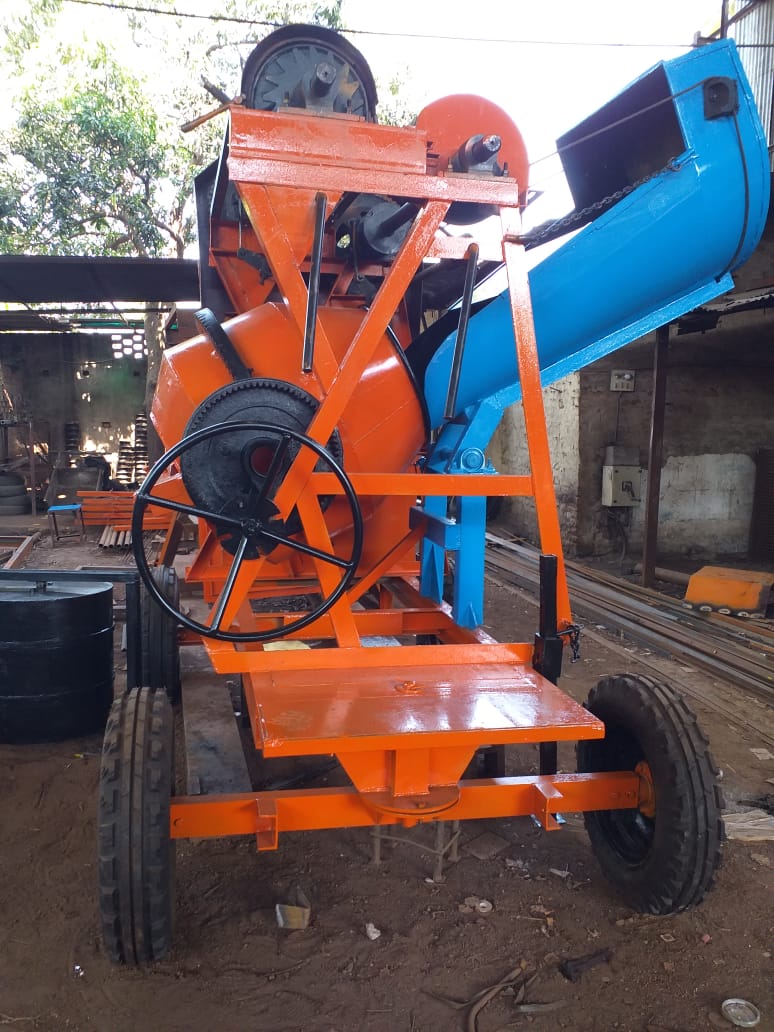
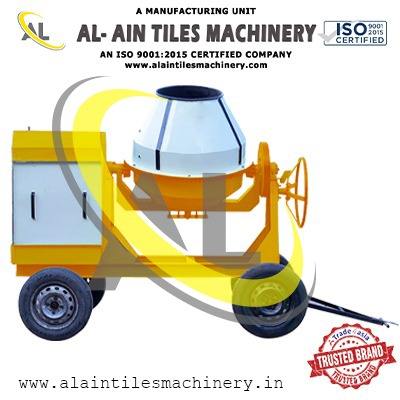
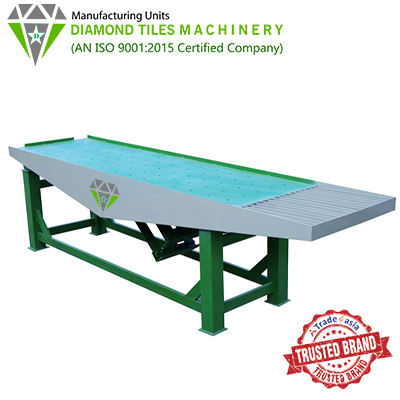
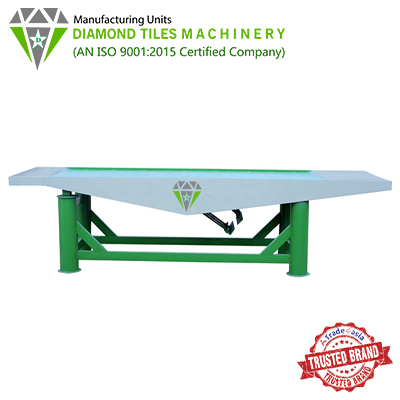
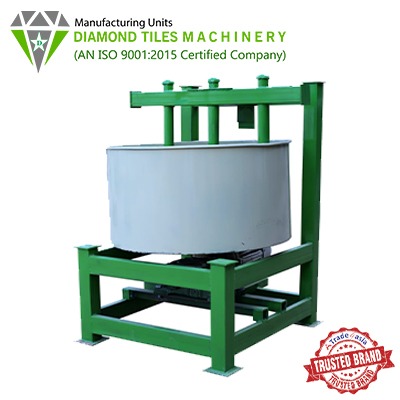
Trade4Asia maps 170+ verified Construction Mixing and Moulding Machine manufacturers, OEMs, and authorised dealers across India — from drum concrete mixers (200 litre / 10/7 CFT to 1000 litre / 40 CFT tilting and reversing drum type; BIS IS 1791 mandatory certification; single-phase and three-phase motor; for site concrete mixing, mortar preparation, and plastering) to pan mixers (250 litre to 1500 litre capacity; forced-action planetary pan design; counter-rotating paddles and scrapers; for precast concrete elements, dry-mix mortar plants, and tile adhesive manufacturing — where drum mixers cannot achieve the homogeneity required), planetary mixers (vertical axis; interchangeable hook, paddle, and whisk attachments; 50 litre to 750 litre; for cement-based tile adhesive, EIFS base coat, self-levelling compounds, grout, and specialty mortar manufacturing), twin-shaft paddle mixers (horizontal axis; intensive mixing for high-strength concrete, RCC paver blocks, and railway sleepers — the most intensive mixing action available), hydraulic paver block moulding machines (vibro-compression moulding; 60mm, 80mm, and 100mm paver block production; interchangeable moulds for kerb stones, hollow blocks, solid blocks, and interlocking tiles; production capacity 1,500–10,000 paver blocks per 8-hour shift), stationary concrete block making machines (egg-laying type and stationary type; hollow blocks, solid blocks, fly-ash blocks, and cellular lightweight blocks), tile pressing and hydraulic tile making machines (for cement tiles, terrazzo tiles, mosaic tiles — 20cm × 20cm to 60cm × 60cm; single and multi-cavity moulds; pressing force 50–500 tonnes), vibrating tables (for compaction of concrete moulded elements and precast items), concrete pan vibrators and internal vibrators (needle vibrators; surface vibrators — poker vibrators for column and wall casting), forced-action mortar mixers (for dry mix mortar, EIFS, and tile grout — 100 litre to 500 litre), and complete turnkey mixing and moulding plant solutions for paver block manufacturers, precast concrete element producers, and dry-mix mortar factories. Whether you are setting up a new paver block manufacturing unit, upgrading a concrete mixer for a construction site, or procuring a complete tile making line, find verified manufacturers with IS 1791 certification, documented mixing homogeneity, production output data, and after-sales spare parts availability.

Ask Price
We are one of the foremost manufacturers of premium e of the foremost manufacturers of premium

Ask Price
We are one of the foremost manufacturers of premium e of the foremost manufacturers of premium
Ask Price
We are one of the foremost manufacturers of premium e of the foremost manufacturers of premium

Ask Price
We are one of the foremost manufacturers of premium e of the foremost manufacturers of premium

Ask Price
We are one of the foremost manufacturers of premium e of the foremost manufacturers of premium

Ask Price
We are one of the foremost manufacturers of premium e of the foremost manufacturers of premium

Ask Price
We are one of the foremost manufacturers of premium e of the foremost manufacturers of premium

Ask Price
We are one of the foremost manufacturers of premium e of the foremost manufacturers of premium

Ask Price
We are one of the foremost manufacturers of premium e of the foremost manufacturers of premium

Ask Price
We are one of the foremost manufacturers of premium e of the foremost manufacturers of premium

Ask Price
We are one of the foremost manufacturers of premium e of the foremost manufacturers of premium

Ask Price
We are one of the foremost manufacturers of premium e of the foremost manufacturers of premium

Ask Price
We are one of the foremost manufacturers of premium e of the foremost manufacturers of premium

Ask Price
We are one of the foremost manufacturers of premium e of the foremost manufacturers of premium

Ask Price
We are one of the foremost manufacturers of premium e of the foremost manufacturers of premium

Ask Price
We are one of the foremost manufacturers of premium e of the foremost manufacturers of premium

Ask Price
We are one of the foremost manufacturers of premium e of the foremost manufacturers of premium

Ask Price
We are one of the foremost manufacturers of premium e of the foremost manufacturers of premium

Ask Price
We are one of the foremost manufacturers of premium e of the foremost manufacturers of premium

Ask Price
We are one of the foremost manufacturers of premium e of the foremost manufacturers of premium
.jpeg)
Ask Price
We are one of the foremost manufacturers of premium e of the foremost manufacturers of premium
Ask Price
We are one of the foremost manufacturers of premium e of the foremost manufacturers of premium
Ask Price
We are one of the foremost manufacturers of premium e of the foremost manufacturers of premium
Ask Price
We are one of the foremost manufacturers of premium e of the foremost manufacturers of premium

Ask Price
We are one of the foremost manufacturers of premium e of the foremost manufacturers of premium
Ask Price
We are one of the foremost manufacturers of premium e of the foremost manufacturers of premium
Ask Price
We are one of the foremost manufacturers of premium e of the foremost manufacturers of premium
Ask Price
We are one of the foremost manufacturers of premium e of the foremost manufacturers of premium
Ask Price
We are one of the foremost manufacturers of premium e of the foremost manufacturers of premium
Ask Price
We are one of the foremost manufacturers of premium e of the foremost manufacturers of premium
Ask Price
We are one of the foremost manufacturers of premium e of the foremost manufacturers of premium
Ask Price
We are one of the foremost manufacturers of premium e of the foremost manufacturers of premium
Ask Price
We are one of the foremost manufacturers of premium e of the foremost manufacturers of premium
Ask Price
We are one of the foremost manufacturers of premium e of the foremost manufacturers of premium
Ask Price
We are one of the foremost manufacturers of premium e of the foremost manufacturers of premium
Ask Price
We are one of the foremost manufacturers of premium e of the foremost manufacturers of premium
Ask Price
We are one of the foremost manufacturers of premium e of the foremost manufacturers of premium
Ask Price
We are one of the foremost manufacturers of premium e of the foremost manufacturers of premium
Ask Price
We are one of the foremost manufacturers of premium e of the foremost manufacturers of premium
Ask Price
We are one of the foremost manufacturers of premium e of the foremost manufacturers of premium
Ask Price
We are one of the foremost manufacturers of premium e of the foremost manufacturers of premium

Ask Price
We are one of the foremost manufacturers of premium e of the foremost manufacturers of premium

Ask Price
We are one of the foremost manufacturers of premium e of the foremost manufacturers of premium

Ask Price
We are one of the foremost manufacturers of premium e of the foremost manufacturers of premium

Ask Price
We are one of the foremost manufacturers of premium e of the foremost manufacturers of premium

Ask Price
We are one of the foremost manufacturers of premium e of the foremost manufacturers of premium
Ask Price
We are one of the foremost manufacturers of premium e of the foremost manufacturers of premium

Ask Price
We are one of the foremost manufacturers of premium e of the foremost manufacturers of premium

Ask Price
We are one of the foremost manufacturers of premium e of the foremost manufacturers of premium

Ask Price
We are one of the foremost manufacturers of premium e of the foremost manufacturers of premium

Ask Price
We are one of the foremost manufacturers of premium e of the foremost manufacturers of premium

Ask Price
We are one of the foremost manufacturers of premium e of the foremost manufacturers of premium

Ask Price
We are one of the foremost manufacturers of premium e of the foremost manufacturers of premium
Ask Price
We are one of the foremost manufacturers of premium e of the foremost manufacturers of premium

Ask Price
We are one of the foremost manufacturers of premium e of the foremost manufacturers of premium

Ask Price
We are one of the foremost manufacturers of premium e of the foremost manufacturers of premium

Ask Price
We are one of the foremost manufacturers of premium e of the foremost manufacturers of premium
Ask Price
We are one of the foremost manufacturers of premium e of the foremost manufacturers of premium
Ask Price
We are one of the foremost manufacturers of premium e of the foremost manufacturers of premium

Ask Price
We are one of the foremost manufacturers of premium e of the foremost manufacturers of premium
Ask Price
We are one of the foremost manufacturers of premium e of the foremost manufacturers of premium

Ask Price
We are one of the foremost manufacturers of premium e of the foremost manufacturers of premium

Ask Price
We are one of the foremost manufacturers of premium e of the foremost manufacturers of premium

Ask Price
We are one of the foremost manufacturers of premium e of the foremost manufacturers of premium

Ask Price
We are one of the foremost manufacturers of premium e of the foremost manufacturers of premium

Ask Price
We are one of the foremost manufacturers of premium e of the foremost manufacturers of premium

Ask Price
We are one of the foremost manufacturers of premium e of the foremost manufacturers of premium

Ask Price
We are one of the foremost manufacturers of premium e of the foremost manufacturers of premium
A precast concrete manufacturer who procures a tilting drum concrete mixer (the standard construction site mixer where the rotating drum tumbles the concrete ingredients together by gravity) to mix concrete for prestressed hollow-core slab production — instead of specifying a forced-action pan mixer or twin-shaft mixer — will produce concrete with unacceptable homogeneity for prestressed applications: drum mixers rely on gravity tumbling to mix concrete, which is effective for standard site concrete (M20–M30) with moderate workability (slump 75–125 mm) but cannot achieve the uniformity required for: prestressed concrete (which must be M45–M60 with very low water-cement ratio — the dry, stiff mix does not tumble effectively in a drum and the coarse aggregate tends to remain at the bottom of the drum while the cement paste rises — resulting in segregation); dry-mix or zero-slump concrete (which is used for paver blocks, hollow blocks, and kerb stones — at this consistency, the mix has no fluidity and the drum mixer cannot move it — the ingredients simply rotate at the bottom of the drum without mixing); tile adhesive and specialty mortar (these require the complete coating of every aggregate particle with binder — achievable only in a forced-action pan or planetary mixer where the paddle arms scrape across the bottom and walls of the bowl at close clearance, ensuring every particle receives mechanical contact); specifying the correct mixer type for the application is the most fundamental quality decision in construction mixing — a drum mixer costs Rs.15,000–80,000 while a pan mixer for equivalent capacity costs Rs.80,000–3,50,000, but the difference in mix quality is not negotiable for applications requiring consistent, homogeneous mix. A paver block manufacturer who purchases a hydraulic vibro-compression moulding machine based solely on the lowest price — without verifying the machine's compaction pressure (kN/cm² or MPa), vibration frequency (Hz), and the quality of the hydraulic system (whether a genuine oil-hydraulic press or a poorly designed pneumatic-over-hydraulic hybrid) — will produce paver blocks that fail the BIS IS 15658 compressive strength test (minimum 35 MPa for M35 grade paver blocks for pedestrian and light vehicle applications; minimum 40 MPa for M40 for heavy vehicle loading): insufficient compaction pressure leaves voids in the block structure that reduce strength and accelerate water absorption (high water absorption leads to surface spalling in Indian monsoon conditions — the characteristic surface crumbling of low-quality paver blocks after 2–3 monsoon cycles); the vibration frequency must be matched to the aggregate size and concrete mix design — inadequate frequency does not compact the zero-slump mix to the required density; the correct machine specification for BIS IS 15658 M35 paver block production: compaction pressure minimum 150–200 kN per mould (equivalent to approximately 2.5–4 kg/cm² on the block face); vibration frequency 50–60 Hz; hydraulic system pressure minimum 150 bar for consistent multi-cycle compaction. India's construction mixing and moulding machine market is growing at 11.4% CAGR, driven by infrastructure expansion (PMGSY rural roads — paver block based; smart city projects; airport and metro construction — precast elements), the housing construction boom, and the growing dry-mix mortar and tile adhesive manufacturing sector.
FAQ's
What is the difference between a drum mixer and a pan mixer, and when should I use each?
A drum concrete mixer uses gravity tumbling: the rotating drum causes the concrete ingredients to tumble and fold over each other as the drum rotates; this mixing action is effective for fluid concrete (slump 75–150 mm) but cannot mix zero-slump or stiff concrete. A pan mixer (forced-action mixer) uses rotating paddles: the paddles are driven mechanically through the concrete mix regardless of how stiff it is; every point in the pan is swept by the paddles, achieving uniform mixing even for zero-slump concrete. When to use a drum mixer: standard site concrete for residential and commercial construction (columns, beams, slabs, foundations — M15 to M30 grade, slump 75–125 mm); mortar for brickwork and plastering; small-volume mixing at remote construction sites (drum mixers are portable); on-site concrete for repair work. When to use a pan mixer (forced action): paver block and interlocking tile concrete (zero slump — essential for block strength consistency); precast concrete elements (M40–M60 — the high cement content and low w/c ratio require forced-action mixing for uniformity); dry-mix mortar manufacturing (tile adhesive, wall putty, grout — uniform powder mixing is only achievable with forced action); coloured concrete (pigmented concrete for decorative elements requires complete pigment distribution — not achievable in a drum mixer); any concrete above M35 grade for critical structural applications. The cost difference: a 500-litre drum mixer costs approximately Rs.30,000–60,000; a 500-litre pan mixer costs approximately Rs.1.4–2.8 lakh — a 3–5× price premium that is justified by the significantly better mix quality for the above applications; using a drum mixer to save cost on a paver block plant will result in blocks that fail the IS 15658 strength test — costing far more in rejected product than the mixer price difference.
What production capacity can I expect from a paver block machine?
The production capacity of a paver block moulding machine depends on: cycle time (seconds per mould operation); number of block cavities per mould; shift duration; practical efficiency. Formula: production per shift = (shift duration in seconds / cycle time) × blocks per mould × efficiency factor. Typical values: semi-automatic hydraulic machine (manual material loading; 30-second cycle; 9 × 60mm blocks per mould; 75% efficiency; 8-hour shift): production = (28,800 / 30) × 9 × 0.75 = 6,480 blocks per shift; fully automatic machine (skip hoist and auto-feeder; 25-second cycle; 9 × 60mm blocks per mould; 85% efficiency): production = (28,800 / 25) × 9 × 0.85 = 8,813 blocks per shift; production in square metres: a standard 200×100×60mm paver block covers 0.02 m²; 6,480 blocks × 0.02 = 129.6 m² per shift; weight: 6,480 blocks × 4.5 kg = 29 tonnes of paver blocks per shift. Common production capacities by machine type: small semi-automatic (1–3 cavity mould; manual loading): 1,000–2,000 blocks/shift; medium semi-automatic (9-block mould; skip hoist): 4,000–6,000 blocks/shift; fully automatic (9-block mould; auto-feeder; PLC): 7,000–12,000 blocks/shift. Factors that reduce actual output below theoretical maximum: material supply delays (mixer batch not ready when moulding machine is ready); mould release issues (block sticking in mould — requires additional ejection time); pallet handling (placing pallets under the mould and removing the finished-block pallet from the moulding station takes 3–5 seconds per cycle); minor stoppages (hydraulic fault, jam in material chute). The mixer must produce concrete faster than the moulding machine consumes it — size the mixer to provide at least 25% spare capacity over the moulding machine's concrete consumption rate.
What is IS 1791 and why is it mandatory for concrete mixers?
IS 1791 (Specification for Batch Type Concrete Mixers) is the Bureau of Indian Standards specification that defines the design, performance, and safety requirements for concrete drum mixers and pan mixers sold in India. The BIS Quality Control Order makes IS 1791 mandatory — all concrete mixers sold in India must carry the BIS ISI mark under IS 1791. Key requirements covered by IS 1791: rated capacity: the nominal batch volume (the mixer nameplate must state both the nominal batch volume in litres and the rated mixing output volume — typically the nominal batch volume × 0.67 for the compacted concrete output); mixing uniformity: IS 1791 Clause 8 specifies the mixing uniformity test — 5 samples are taken from different positions in the drum after mixing, and the coefficient of variation (CV) of the water-cement ratio and coarse aggregate content must be below specified limits (approximately 6% CV); this test ensures the mixer actually produces homogeneous concrete, not just tumbled ingredients; drum speed: specified as a function of drum diameter to produce effective tumbling action (too fast — centrifugal force holds the concrete to the drum wall; too slow — concrete does not tumble and mix); motor power: minimum power specified per capacity class; safety requirements: drum guard (prevents operator from reaching into the rotating drum); tilting latch (prevents the drum from inadvertently tilting during mixing); water gauge (to measure and control the water added per batch); marking requirements: rated capacity; mixing time; drum speed; manufacturer details; ISI mark. The ISI mark provides assurance of: electrical safety (motor protection; earthing); mechanical safety (drum guard; tipping latch); mixing performance (IS 1791 Clause 8 uniformity). Always verify the ISI licence number at bis.gov.in before accepting any mixer delivery.
What is the minimum compaction pressure required for IS 15658 M35 paver blocks?
IS 15658 (Precast Concrete Blocks for Paving) specifies the minimum compressive strength for M35 paver blocks as 35 MPa at 28 days (characteristic compressive strength). The compaction pressure required from the moulding machine to achieve M35 strength depends on: the concrete mix design (cement content, aggregate gradation, water-cement ratio); the vibration frequency and duration; and the hydraulic compaction pressure. Practical guidance: for a standard paver block mix design (OPC 53 cement: 350 kg/m³; crushed 10mm aggregate: 900 kg/m³; stone dust: 600 kg/m³; w/c ratio: 0.32–0.35): the hydraulic compaction pressure on the block face should be: minimum 2.5 MPa (approximately 25 N/cm² or 25 kg/cm²) for M35 grade (35 MPa characteristic strength); minimum 3.0–4.0 MPa for M40 grade (40 MPa); minimum 5.0 MPa for M50 grade (50 MPa — for heavy traffic paving). How to calculate the machine's compaction pressure: compaction force (kN) = hydraulic system pressure (bar) × main cylinder piston area (cm²) × 0.1; compaction pressure (MPa) = compaction force (kN) × 1000 / total mould cavity area (mm²); example: 150 bar hydraulic system; main cylinder 200 mm diameter (piston area = π/4 × 20² = 314 cm²): compaction force = 150 × 314 × 0.1 = 4,710 kN; wait — let me recalculate: 1 bar = 0.1 MPa = 100,000 Pa = 10 N/cm²; compaction force = 150 bar × 10 N/cm² per bar × 314 cm² = 471,000 N = 471 kN; for 9 × 60mm paver blocks (each 200×100 mm = 200 cm²; 9 blocks = 1800 cm²): compaction pressure on block face = 471,000 N / (1800 cm² × 100 mm²/cm²) = 471,000 / 18,000 = 2.62 N/mm² = 2.62 MPa; this is borderline for M35 grade (should be minimum 2.5 MPa) — a 200 bar system or a larger cylinder (250 mm) would provide a more comfortable margin for consistent M35 production.
How do I size a concrete mixer to match a paver block moulding machine?
The concrete mixer capacity must match the paver block moulding machine's concrete consumption rate so that the mixer delivers concrete before the moulding machine's wait time becomes the production bottleneck. Step-by-step sizing: determine the moulding machine's concrete consumption rate: moulding machine cycle time: 30 seconds; blocks per cycle: 9 blocks of 200×100×60mm (volume per block: 0.002 m³ concrete after compaction; with 12% compaction loss: 0.00224 m³ per block uncompacted); concrete volume per moulding cycle: 9 × 0.00224 = 0.0202 m³; cycles per hour (at 100% efficiency): 3,600 / 30 = 120 cycles/hour; concrete consumption rate: 120 × 0.0202 = 2.42 m³/hour; at 80% efficiency: 1.94 m³/hour effective; size the mixer to match this rate with 25% buffer: required mixer output: 1.94 × 1.25 = 2.42 m³/hour; if the mixer cycle time is 2.5 minutes (1.5 min mixing + 1 min loading and discharge): batches per hour = 60 / 2.5 = 24 batches/hour; required mixer volume per batch: 2.42 / 24 = 0.101 m³ = 101 litres; specify a 200-litre pan mixer (with 100% spare capacity over the minimum requirement — the extra capacity handles the periods when the cycle time is longer due to material variations). For a larger plant: if the target production is 8,000 blocks per shift: concrete volume: 8,000 × 0.00224 m³ = 17.92 m³ per shift; rate: 17.92 / 8 hours = 2.24 m³/hour; mixer required: 2.24 × 1.25 / 24 batches/hour = 116 litres per batch; specify a 250-litre pan mixer; the rule of thumb: the mixer volume in litres should be approximately equal to the moulding machine's concrete consumption per minute (in litres) multiplied by the mixing cycle time in minutes, with a 25–50% safety margin.
Provide your details and get multiple competitive quotes at no cost.