
India's Most Trusted Source for Car Air Conditioning Services — 220+ Verified Service Centres for AC Gas Refilling, Compressor Repair, Condenser Replacement & Complete AC System Overhaul for All Car Brands
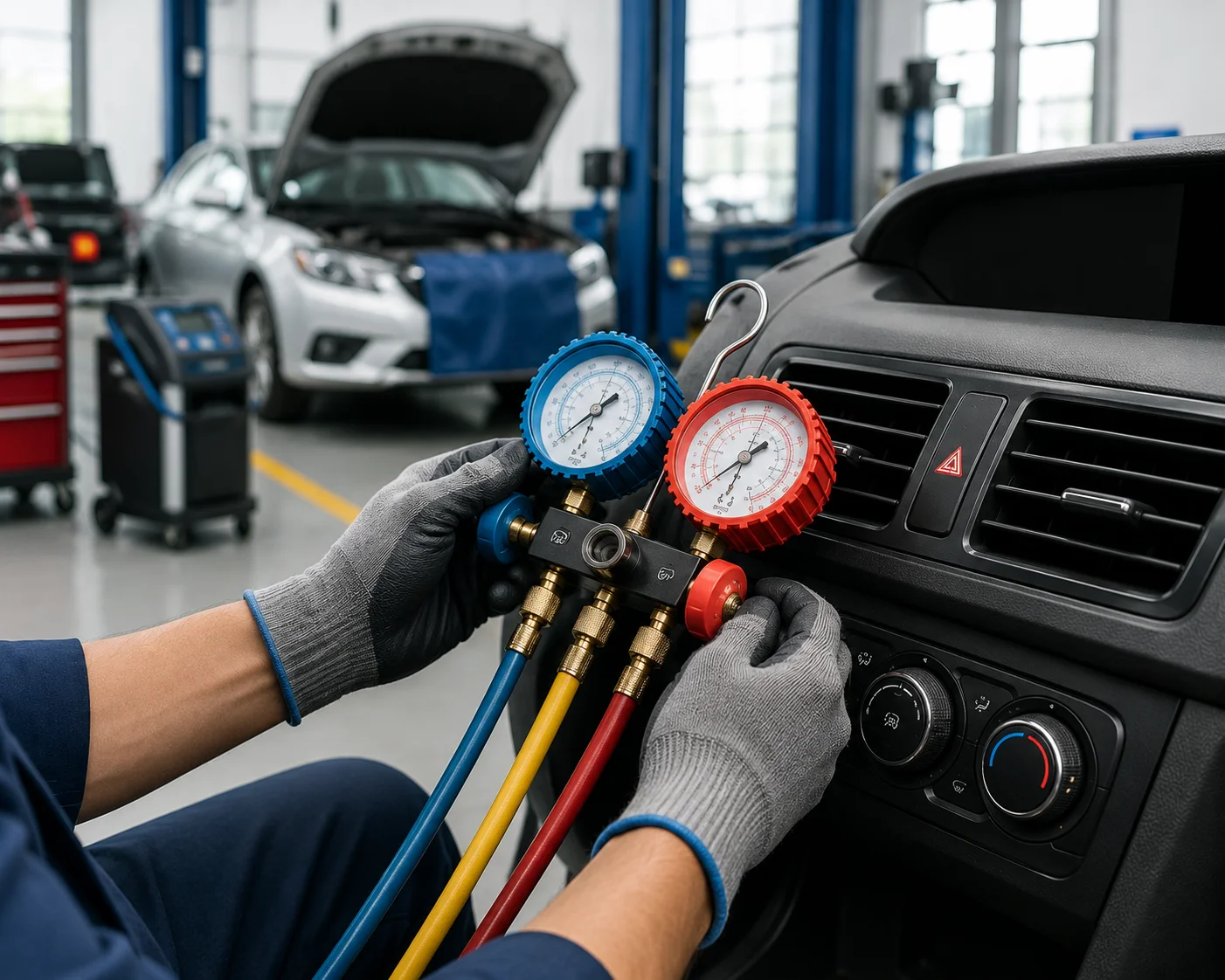
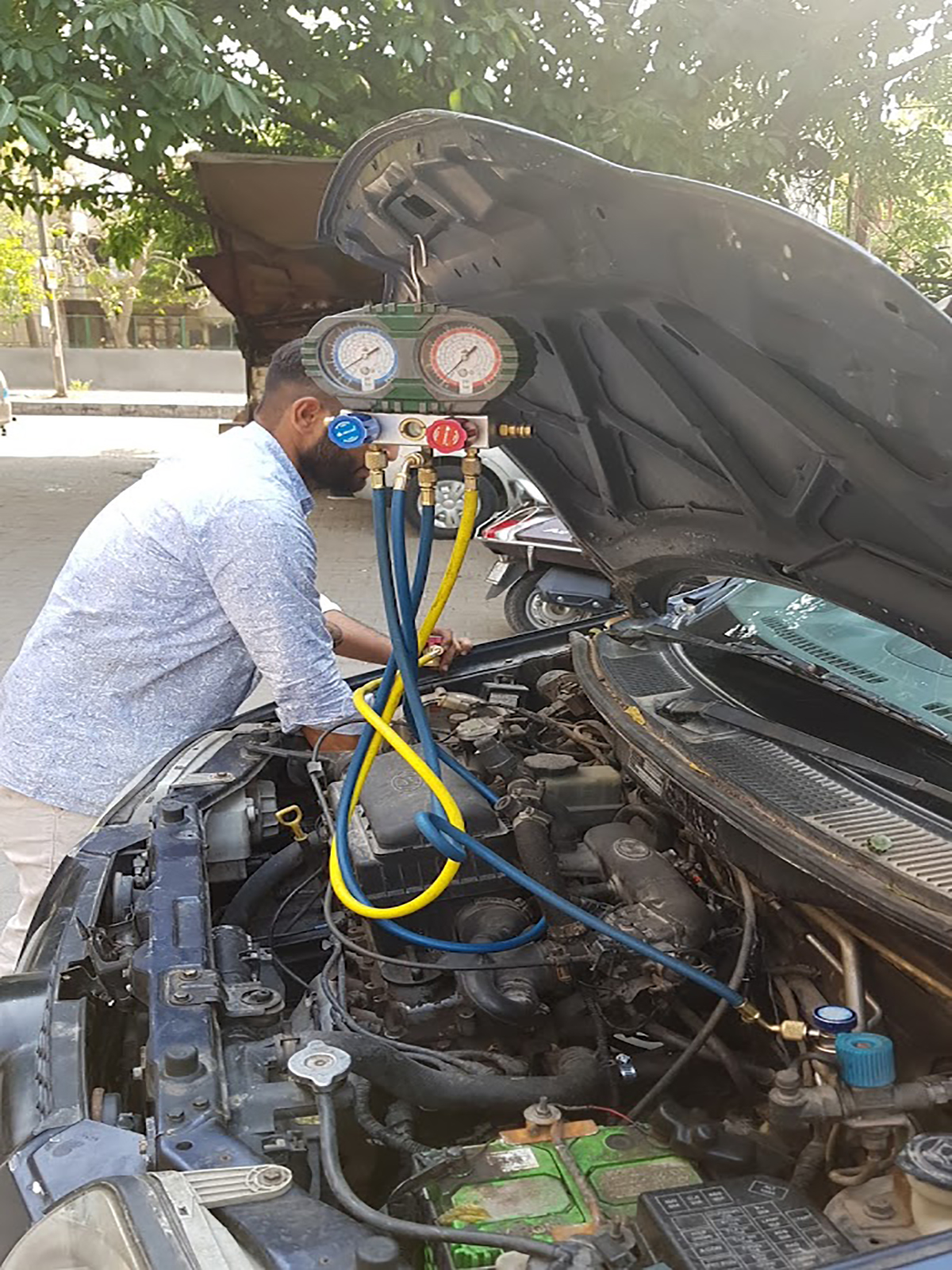
Trade4Asia maps 220+ verified Car AC Service centres, automobile workshops, and fleet maintenance specialists across India — from standard car AC gas refilling and top-up (R-134a and R-1234yf refrigerant; electronic leak detection; vacuum testing before recharge; correct refrigerant quantity per vehicle OEM specification) to complete car AC system diagnosis (electronic manifold gauge set; AC performance testing — inlet and outlet temperature differential; compressor clutch current draw; pressure readings — high side and low side; evaporator temperature; blower motor speed verification), compressor repair and replacement (piston-type, scroll, rotary, and variable displacement compressors; all brands — Denso, Sanden, Valeo, Delphi, Maruti OEM, Hyundai OEM; compressor clutch coil testing and replacement; bearing replacement; compressor oil top-up; compatible replacement units for all Indian car models), condenser cleaning, repair, and replacement (aluminium multi-flow condensers; brazed-joint repair; fin straightening; blocked condenser cleaning; replacement condensers for all Indian car models), evaporator coil cleaning and replacement (foaming evaporator cleaner treatment; evaporator leak detection with UV dye; blocked evaporator drain pipe cleaning; evaporator replacement with dashboard partial disassembly), expansion valve and thermostatic expansion valve (TXV) replacement, receiver drier and accumulator replacement, cabin air filter replacement and HEPA upgrade, blower motor repair and replacement, AC duct cleaning and sanitisation (anti-bacterial and anti-fungal treatment for evaporator and duct system), AC belt and tensioner replacement, fleet car AC service contracts (quarterly or biannual preventive maintenance for 10–500 vehicle fleets — company cars, taxi aggregators, ambulance fleet, police vehicles), and EV and hybrid vehicle AC system service (R-134a and R-1234yf; high-voltage electric compressor safety protocols for BEV and PHEV vehicles). Whether you are a fleet manager maintaining 100 company sedans, a taxi aggregator servicing 50 vehicles monthly, or an individual car owner with an AC that is not cooling effectively, find verified service centres with OEM-quality refrigerant, calibrated manifold gauges, electronic leak detectors, and trained AC technicians.
Ask Price
We are one of the foremost manufacturers of premium e of the foremost manufacturers of premium
Ask Price
We are one of the foremost manufacturers of premium e of the foremost manufacturers of premium
Ask Price
We are one of the foremost manufacturers of premium e of the foremost manufacturers of premium
Ask Price
We are one of the foremost manufacturers of premium e of the foremost manufacturers of premium
Ask Price
We are one of the foremost manufacturers of premium e of the foremost manufacturers of premium
Ask Price
We are one of the foremost manufacturers of premium e of the foremost manufacturers of premium
Ask Price
We are one of the foremost manufacturers of premium e of the foremost manufacturers of premium
Ask Price
We are one of the foremost manufacturers of premium e of the foremost manufacturers of premium
Ask Price
We are one of the foremost manufacturers of premium e of the foremost manufacturers of premium
Ask Price
We are one of the foremost manufacturers of premium e of the foremost manufacturers of premium
Ask Price
We are one of the foremost manufacturers of premium e of the foremost manufacturers of premium
Ask Price
We are one of the foremost manufacturers of premium e of the foremost manufacturers of premium
Ask Price
We are one of the foremost manufacturers of premium e of the foremost manufacturers of premium
Ask Price
We are one of the foremost manufacturers of premium e of the foremost manufacturers of premium
Ask Price
We are one of the foremost manufacturers of premium e of the foremost manufacturers of premium
Ask Price
We are one of the foremost manufacturers of premium e of the foremost manufacturers of premium
Ask Price
We are one of the foremost manufacturers of premium e of the foremost manufacturers of premium
Ask Price
We are one of the foremost manufacturers of premium e of the foremost manufacturers of premium
Ask Price
We are one of the foremost manufacturers of premium e of the foremost manufacturers of premium
Ask Price
We are one of the foremost manufacturers of premium e of the foremost manufacturers of premium
Ask Price
We are one of the foremost manufacturers of premium e of the foremost manufacturers of premium
A fleet manager who authorises car AC gas top-ups for 50 company vehicles at a roadside workshop that does not perform a pre-charge vacuum test and leak detection — simply topping up refrigerant without first evacuating the system and locating the source of refrigerant loss — will find that the same vehicles return for AC top-up 3–4 months later as the refrigerant continues to leak from the unresolved leak; the repeated top-up cost (Rs.800–1,500 per top-up × 50 vehicles × 3 top-ups per year = Rs.1.20–2.25 lakh annually in refrigerant top-up alone) is significantly higher than the cost of a single proper repair (leak detection, component replacement, evacuation, and recharge: Rs.3,000–6,000 per vehicle — a one-time cost for each of the affected vehicles); additionally, an AC system with a leak will contain moisture (atmospheric humidity enters through the same path the refrigerant leaks out) — moisture in the AC system causes: ice formation at the expansion valve (blocking refrigerant flow and causing intermittent cooling — the classic 'AC cools and then stops cooling' complaint); acid formation when the refrigerant and moisture react (hydrochloric and hydrofluoric acid from R-134a + moisture — the acid attacks the compressor's aluminium and copper components, causing premature compressor failure); the correct service standard is: never recharge a system that has lost refrigerant without first performing a leak test; the vacuum test (evacuate the system to below 500 microns of mercury and hold for 30 minutes — if the vacuum holds, the system is leak-free; if it rises, there is a leak) is the most basic quality check, and any workshop that does not perform it is not providing professional AC service. A car owner who accepts a 'compressor replacement' quotation from a workshop that has not properly diagnosed the actual cause of AC failure — assuming the compressor is the fault without using a manifold gauge set to measure system pressures and verify compressor performance — may spend Rs.8,000–18,000 on a compressor replacement that does not fix the problem because the actual cause was a blocked condenser (which caused high-side pressure to spike and triggered the compressor's safety cut-off — making it appear that the compressor was at fault), or a failed expansion valve (which prevented refrigerant from reaching the evaporator — correctly diagnosed, the expansion valve costs Rs.800–2,500 to replace vs. Rs.8,000–18,000 for a compressor); the correct diagnostic sequence for 'AC not cooling' starts with: system pressure measurement (manifold gauge set — low side and high side pressures identify the fault category with high accuracy before any component is opened); electrical circuit check (compressor clutch coil resistance, clutch engagement voltage, high-pressure switch, thermostat switch, blower motor circuit); temperature differential measurement (inlet air temperature vs. AC outlet temperature — a properly functioning AC system should produce outlet air 10–14°C below the inlet air at moderate ambient temperature); a workshop that quotes component replacement without performing these basic diagnostic steps first is guessing — and charging the customer for each guess. India's car AC service market is growing at 12.8% CAGR, driven by rising car ownership (India surpassed Japan as the world's 3rd largest car market in 2023), increasing ambient temperatures, and the growing proportion of premium vehicles with climate control systems requiring specialist service.
FAQ's
Why is my car AC not cooling even after a gas refill?
If your car AC is not cooling after a recent gas refill, the most likely causes are: wrong refrigerant quantity: if the technician charged by pressure rather than weight, the system may be overcharged or undercharged — overcharge causes the high-pressure cutout to trip the compressor (AC appears to work then stops); undercharge causes insufficient cooling; request a manifold gauge pressure check to verify the charge is correct for the ambient temperature. Moisture in the system: if the system was recharged without a vacuum test, moisture may have remained and is forming ice at the expansion valve — the AC cools when the compressor runs, then stops cooling as ice builds up, then resumes cooling when the ice melts; solution: recover refrigerant, deep vacuum (below 200 microns for at least 45 minutes), then recharge. Leak not properly repaired: if a leak was found but the repair was inadequate (a temporary stop-leak product was used instead of a proper repair), the refrigerant is still escaping; the system is again below specification charge. Compressor clutch engagement issue: the compressor clutch may not be engaging consistently — a marginal clutch coil or gap issue may have been present before the recharge and is now more apparent; a clamp meter check of the clutch coil circuit will confirm. Condenser blockage: a blocked condenser (from dust, insects, or debris) causes high-side pressure to spike regardless of correct refrigerant charge — the high-pressure cutout trips the compressor; cleaning the condenser resolves this. Independent of refrigerant: the blower motor may be failing (reduced airflow reduces cooling felt in the cabin despite correct AC system function). Request a full diagnostic (manifold gauge pressure reading + temperature differential test + clutch current check) from the workshop rather than accepting another 'top-up' as the solution.
How often should I get my car AC gas refilled?
A properly functioning and well-sealed car AC system should not require refrigerant top-up at regular intervals — the refrigerant does not 'wear out' or deplete in a healthy sealed system. If your car's AC requires refrigerant every 1–2 years: there is a slow leak in the system (at a fitting, shaft seal, hose, or through the condenser or evaporator); rather than repeated top-ups, have the leak found and repaired — this eliminates the ongoing cost of refrigerant and prevents the damage that moisture-entry through the leak causes to the system. When AC gas top-up is appropriate: if the vehicle is more than 10 years old: minor seepage through aged hoses, O-rings, and shaft seals is normal in very old systems; if the cooling has gradually reduced over 3–4 years: a small top-up (after leak detection and vacuum test) is reasonable; when a refrigerant-related component has been replaced (compressor, condenser, evaporator — the system must be evacuated and recharged after opening for these repairs); annual pre-summer AC service: many workshops recommend an annual AC check (not necessarily a refill — a system pressure check to confirm the charge is still adequate). For most well-maintained cars under 8 years old: a refrigerant top-up should not be needed more than once in 5–7 years if the system has no leaks. If your workshop recommends annual gas refills as a 'service standard': this suggests they are not properly identifying and fixing leaks — a top-up without leak detection and repair is not a professional service.
What is the difference between R-134a and R-1234yf refrigerant?
R-134a (HFC-134a) and R-1234yf (HFO-1234yf) are both hydrofluorocarbon-based refrigerants used in automotive air conditioning, but they have important differences. R-134a: the standard refrigerant for all vehicles manufactured before approximately 2020–2022 in India; GWP (Global Warming Potential): 1,430 — a potent greenhouse gas; operating pressures (at 38 deg C ambient): low side 2.0–2.5 bar; high side 12–16 bar; cost: approximately Rs.500–800 per kg; compatible oil: PAG 46, PAG 100, or PAG 150 (as specified by compressor manufacturer); the most widely available refrigerant at all workshops. R-1234yf: the next-generation refrigerant mandated for new vehicles under the EU MAC (Mobile Air Conditioning) Directive; increasingly specified for Indian vehicles from approximately 2020 onwards (Kia Seltos facelift, newer Hyundai models, newer Korean and European imports); GWP: 4 — 99.7% lower greenhouse impact than R-134a — specifically developed to replace R-134a in automotive AC; operating pressures: slightly higher than R-134a — low side approximately 2.5–3.0 bar; high side 15–19 bar; compatible oil: POE (Polyolester) oil — NOT PAG oil; cost: approximately Rs.4,000–6,000 per kg — significantly more expensive; requires dedicated service equipment (SAE J2843) with fittings that prevent mixing with R-134a equipment. The critical rule: these two refrigerants are NOT interchangeable; mixing them contaminates the system; always check the refrigerant type specification on the sticker under the bonnet before service; a workshop servicing an R-1234yf vehicle must have dedicated R-1234yf equipment and stock — not all workshops have this capability yet in India.
How do I know if my car AC compressor needs replacement?
The AC compressor needs replacement when it has a genuine internal failure — but many 'compressor replacements' recommended in Indian workshops are actually unnecessary because the true fault has not been properly diagnosed. Signs that indicate genuine compressor failure: grinding, squealing, or knocking noise from the compressor body when the AC clutch engages (the sound stops when AC is switched off — confirming the compressor is the noise source); seized compressor — the compressor shaft cannot be turned by hand; the belt slips or the engine stalls momentarily when AC is switched on; pressure equalisation — manifold gauges show the same pressure on low side and high side after the compressor has been running for 5 minutes — indicating internal valve failure (the compressor is running but not pumping); heavy oil deposit around the front of the compressor body — indicating shaft seal failure (refrigerant + oil is escaping through the front seal); signs that do NOT indicate compressor failure (diagnose further before replacing): the compressor clutch is not engaging — first check the electrical circuit (clutch coil resistance, relay, high-pressure switch, thermostat switch, low-pressure switch) before assuming the compressor is faulty; both the electrical check and the manifold gauge reading must indicate internal compressor fault before authorising replacement; the high-side pressure is very high — this is usually a condenser blockage problem, not a compressor problem; the AC cools intermittently — this is usually an expansion valve moisture-ice issue or a thermostat switch fault, not a compressor problem; a reliable indicator test: take a manifold gauge reading before authorising any replacement; if the low-side and high-side pressures equalise (both converge to the same value when the compressor runs) — internal valve failure is confirmed and compressor replacement is appropriate.
What is the vacuum test and why is it important before AC gas filling?
The vacuum test (also called evacuation) is the process of using a vacuum pump to remove all gas (air and refrigerant vapour) from the AC system before charging it with fresh refrigerant. How it works: the manifold gauge set is connected to the vehicle's high-side and low-side service ports; the vacuum pump is started and runs for 20–30 minutes (longer for larger systems or if moisture is suspected); the system pressure drops below atmospheric pressure — down to below 500 microns of mercury (Hg) — deep in the vacuum range; at this pressure level: air is removed from the system (air in an AC system causes non-condensables — the air does not condense in the condenser, causing high-side pressure to rise above normal and reducing cooling efficiency); moisture is removed by boiling — water boils at a much lower temperature under vacuum (at 500 microns Hg pressure, water boils at approximately 0 deg C — the vacuum pump effectively 'boils off' moisture from the system at room temperature by reducing the pressure below the water's vapour pressure); after achieving the target vacuum level, the pump is shut off and the manifold valves closed; the vacuum gauge is observed for 30 minutes — if the vacuum holds stable (within 50 microns of the achieved level): the system is confirmed leak-free and moisture-free — recharging can proceed; if the vacuum rises toward atmospheric pressure: the system has a leak — the refrigerant charge would simply escape through the same leak; why it matters: a system recharged without vacuum testing: may still have a leak (the refrigerant tops up and immediately begins leaking again); has residual air (causes high-side pressure spikes and reduced cooling); has residual moisture (causes ice blockage at expansion valve; acid formation from refrigerant + moisture reaction); the vacuum test prevents all of these failure modes — it is the minimum quality standard for a professional AC recharge.
Provide your details and get multiple competitive quotes at no cost.